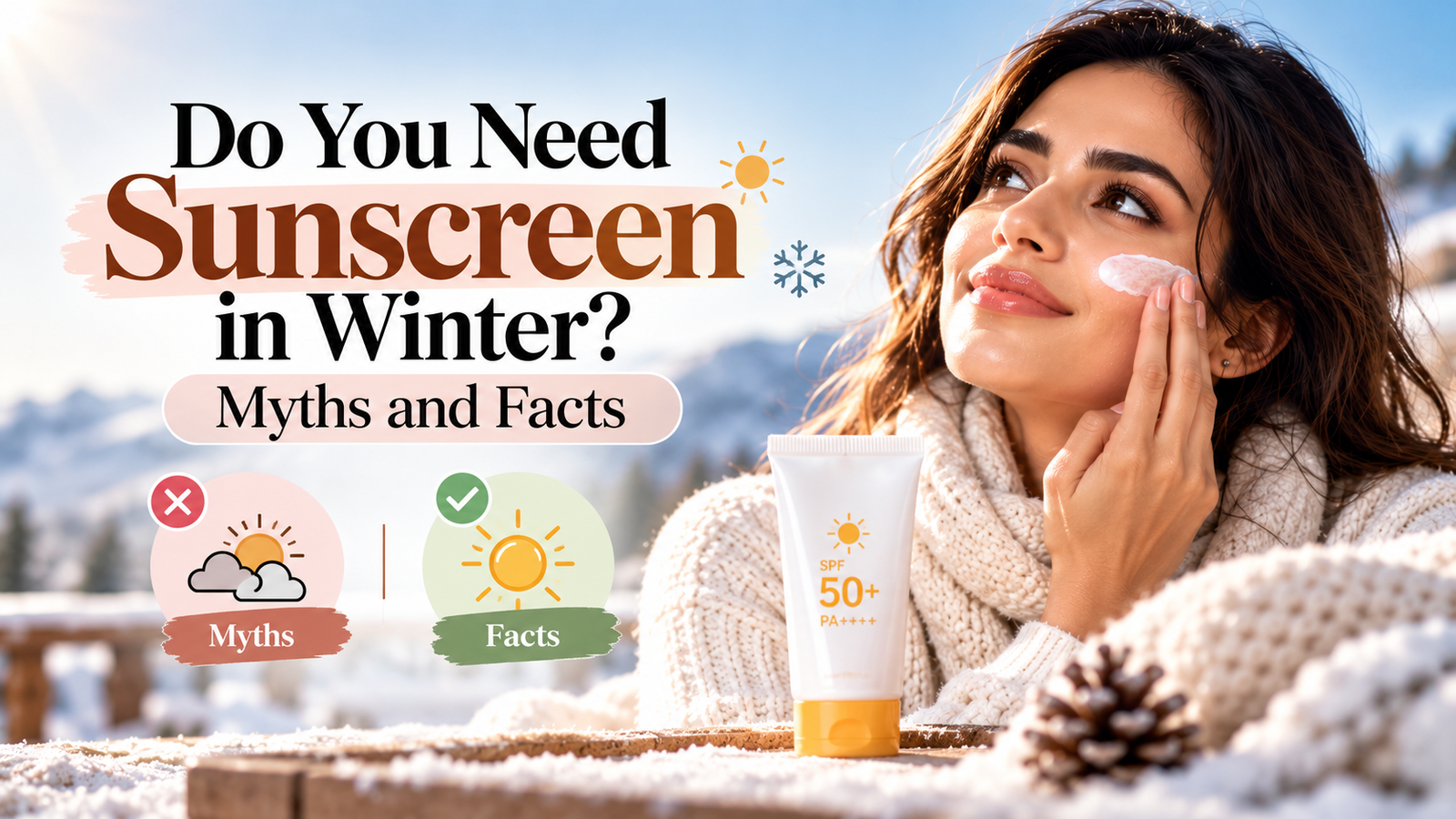
When the weather cools and the sun feels softer, many people quietly drop sunscreen from their routine. It feels unnecessary when you are not sweating or squinting. But the question of whether you need sunscreen in winter has a clear answer from dermatologists, and the reasons are worth understanding. This guide explains the most common winter sunscreen myths, what is actually true, and how to make daily sun protection easy.
Quick answer: Yes, you need sunscreen in winter. Ultraviolet (UV) rays are present all year, they pass through clouds and light fog, and they can reach your skin even through windows. Applying a broad-spectrum sunscreen of SPF 30 or higher every morning helps protect against tanning, pigmentation and premature ageing in every season.
Why Do You Still Need Sunscreen in Winter?
There are two main kinds of UV rays that matter for skin. UVB rays are the ones that cause sunburn and are strongest in bright, direct sun. UVA rays are present at similar levels through much of the year and penetrate deeper into the skin, where they contribute to ageing and pigmentation. Because UVA does not drop as sharply in cooler months, your skin keeps getting exposure even when the temperature falls. In many parts of India the winter sun is also still intense during the middle of the day.
What Are the Common Winter Sunscreen Myths?
Myth 1: I do not sweat or tan in winter, so I do not need sunscreen
Not feeling hot does not mean UV is absent. Tanning and pigmentation build up slowly, and the effect of repeated unprotected exposure can show up weeks or months later as dark patches and uneven tone.
Myth 2: Cloudy days are safe
Clouds and fog can block some visible light, but a significant part of UV radiation can still pass through. The American Academy of Dermatology recommends using sunscreen daily, including on cloudy days.
Myth 3: Sunscreen is only for the beach or for people who go out in the sun
Short exposures add up. A walk to the market, a commute or sitting near a bright window all count. A simple morning habit covers these everyday moments.
Myth 4: A moisturizer with SPF is enough
Some moisturizers do contain SPF, but most people do not apply enough of them to get the protection written on the label. A dedicated sunscreen, applied in the right amount, is a more reliable choice.
Myth 5: Sunscreen feels too heavy for dry winter skin
Modern sunscreens come in lightweight and hydrating textures. If your skin feels dry, apply a moisturizer first and sunscreen on top, so the skin stays comfortable through the day.
How Much Sunscreen Should You Apply?
Most people apply far less sunscreen than they need, which reduces the protection they actually get. A helpful guide for the face and neck is about two finger lengths of sunscreen. Apply it as the last step of your morning routine, after moisturizer, and give it a minute or two to settle. If you are outdoors for long periods, reapply every two to three hours.
| Situation | Sunscreen needed? | Tip |
|---|---|---|
| Sunny winter afternoon outdoors | Yes | Apply generously, reapply if outside for hours |
| Cloudy or foggy morning | Yes | UV can still pass through clouds |
| Working next to a bright window | Yes | UVA can pass through glass |
| Staying fully indoors, away from windows | Lower risk | A morning application is still a good habit |
How to Fit Sunscreen Into a Winter Routine
- Cleanse gently with lukewarm water.
- Apply a hydrating serum if you use one.
- Apply moisturizer on slightly damp skin.
- Finish with sunscreen on your face, neck and the back of your hands and ears.
- At night, cleanse well to remove sunscreen, dust and pollution.
How Does Beaukind Sunscreen Fit In?
Beaukind is an Indian, cruelty-free skincare brand, and sun protection is a core part of its routine. The Beaukind Sunscreen is designed as the last step of your morning routine, and it pairs naturally with the Beaukind Moisturizer. If you like to keep things simple, the Moisturizer and Sunscreen combo covers both steps together. To learn how SPF 50 works and what it can and cannot do, read our guide on how SPF 50 sunscreen helps prevent visible skin ageing.
Extra Tips for Better Sun Protection
- Do not forget the neck, ears and the back of your hands.
- Use sunscreen every day, not only when you plan to be outdoors.
- Combine sunscreen with other habits such as a hat or sunglasses when the sun is strong.
- Patch test any new sunscreen, and see a dermatologist if you notice irritation.
What Does SPF Actually Mean?
SPF stands for Sun Protection Factor, and it mainly describes protection against UVB rays, the type that causes sunburn. According to commonly cited dermatology guidance, SPF 30 blocks roughly 97 percent of UVB rays and SPF 50 blocks roughly 98 percent. The difference between them looks small, but a higher SPF can offer a little more margin when you do not apply quite enough product. Look for the words broad-spectrum on the label, which indicate that the product also helps protect against UVA rays, the ones linked with ageing and pigmentation.
Which Sunscreen Texture Works Best for Dry Winter Skin?
If your skin feels dry in winter, choose a sunscreen with a smooth, cream-like or lightweight lotion texture rather than a very matte or alcohol-heavy one. Apply a moisturizer first so that the sunscreen sits comfortably on top. If your skin is oily, a lightweight fluid or gel-cream texture usually feels better. The best sunscreen is always the one you enjoy wearing, because you are far more likely to use it every day.
Does Daily Sunscreen Affect Vitamin D?
This is a common worry, especially because many people in India have low vitamin D levels. Everyday sunscreen use has not been shown to cause vitamin D deficiency for most people, because normal use rarely blocks all UV and because sunscreen is usually applied only to the face and neck. If you are concerned about your vitamin D, speak to your doctor about a blood test, safe dietary sources or supplements rather than skipping sunscreen.
Key Takeaways
- UV rays are present in every season, including winter.
- Clouds, fog and windows do not remove all UV exposure.
- Use a broad-spectrum sunscreen of SPF 30 or higher every morning.
- Apply about two finger lengths for the face and neck, and reapply when outdoors for long.
- Keep sunscreen as the last step after moisturizer in your routine.
Written by the Beaukind Skincare Team.