If dark spots from old breakouts, sun exposure, or just uneven tone keep showing up in your mirror, you have probably seen alpha arbutin for dark spots mentioned on serum and facewash labels. It is one of the most commonly recommended brightening actives in Indian skincare right now, and for good reason: it targets pigmentation at the source rather than just masking it.
In this guide, we break down what alpha arbutin actually does, how long it realistically takes to show results, how it compares to other brighteners, and how to fit it into a routine without overdoing it.
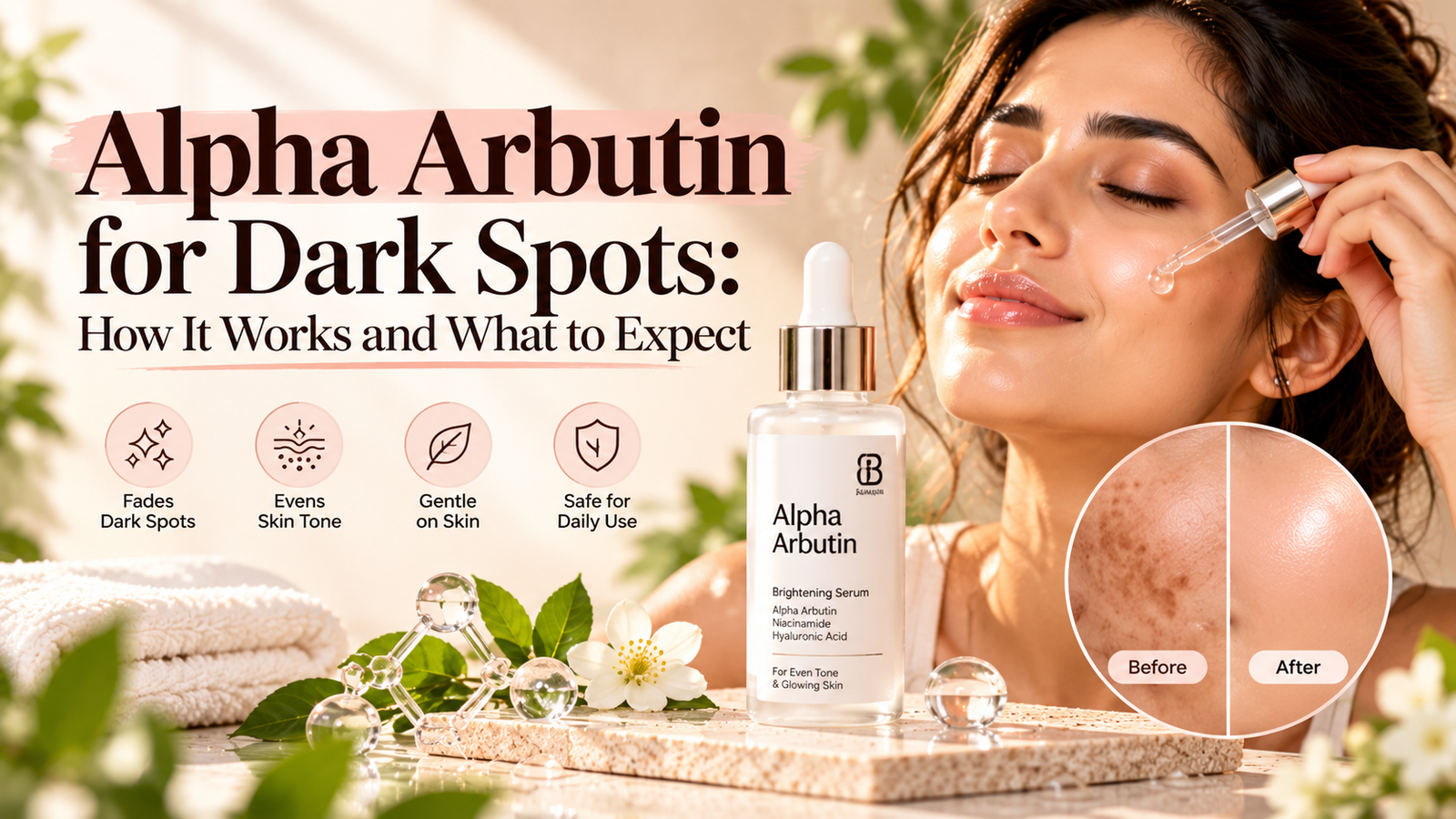
Direct answer: Alpha arbutin fades dark spots by slowing down tyrosinase, the enzyme your skin uses to produce melanin. With consistent daily use alongside sunscreen, most people notice a visible reduction in dark spots and uneven tone over 8 to 12 weeks, though deeper or long-standing marks can take longer.
What Is Alpha Arbutin and How Does It Work?
Alpha arbutin is a plant-derived brightening compound, often sourced from bearberry, that is chemically related to hydroquinone but considered gentler. Instead of bleaching skin, it works upstream in the pigmentation process.
When your skin is exposed to UV light, inflammation, or injury (like a popped pimple), it ramps up an enzyme called tyrosinase to produce more melanin as a protective response. That extra melanin is what shows up as a dark spot. Alpha arbutin slows this enzyme down, which means less new pigment gets made while your skin's natural turnover gradually fades the existing spot.
How Long Does Alpha Arbutin Take to Fade Dark Spots?
Most people using alpha arbutin consistently, once or twice daily, start noticing a visible difference in tone evenness around 6 to 8 weeks, with more noticeable fading of individual spots by 10 to 12 weeks. This is a general pattern reported across skincare sources, not a guaranteed timeline, since pigmentation depth, skin type, and sun exposure all affect the pace.
Fresh, shallow marks (like a spot left after a pimple healed) typically respond faster than old sun spots or melasma, which sit deeper in the skin and may need a dermatologist's input alongside topical care.
Alpha Arbutin vs Beta Arbutin vs Other Brighteners
Not all arbutin is the same, and labels can be confusing. Here is a quick comparison to help you read ingredient lists with more confidence.
| Ingredient | How It Works | Best For |
|---|---|---|
| Alpha Arbutin | Slows tyrosinase; more stable and effective form | Daily use, sensitive to normal skin |
| Beta Arbutin | Same mechanism, less potent and less stable | Budget formulations |
| Niacinamide | Blocks pigment transfer to skin surface, calms redness | Combination use with arbutin |
| Vitamin C | Antioxidant that also inhibits melanin formation | Morning brightening + protection |
Because alpha arbutin and niacinamide work through different parts of the pigmentation pathway, they are often paired together in the same product or routine for a stronger combined effect.
Is Alpha Arbutin Safe for Sensitive or Indian Skin Tones?
Alpha arbutin is generally considered one of the more tolerable brightening actives, since it does not exfoliate or strip the skin the way acids can. It is also commonly used across Indian skincare formulations because melanin-related pigmentation (post-acne marks, tanning, and sun spots) is such a common concern here.
That said, being gentle does not mean risk-free for everyone. Anyone with very reactive or eczema-prone skin should still patch test on the inner arm for 24 to 48 hours before applying a new product to the face.
Can You Use Alpha Arbutin on Body Skin Too?
Dark spots are not limited to the face. Underarms, elbows, knees, and skin that has tanned unevenly after long days outdoors can all benefit from the same tyrosinase-slowing approach. The main difference with body skin is that absorption tends to be slower because the skin is often thicker, so results there can take slightly longer than on the face. Consistency still matters more than the exact product you choose, and pairing any brightening step with a body moisturiser and sunscreen on exposed areas gives the best chance of even results over time.
How to Use Alpha Arbutin in Your Routine
- Cleanse with a gentle facewash to remove dirt and oil without disrupting your skin barrier.
- Apply an alpha arbutin serum, such as the Beaukind Bioglow Faceserum, which combines alpha arbutin with niacinamide and glutathione, to clean, slightly damp skin.
- Follow with a moisturiser to lock in hydration and support your skin barrier while the active works.
- Apply sunscreen every morning, without exception. Sun exposure continues to trigger pigmentation, which can undo the progress you are making.
Key Takeaways
- Alpha arbutin fades dark spots by slowing tyrosinase, the enzyme behind melanin production.
- Visible results generally take 8 to 12 weeks of consistent, daily use.
- It pairs well with niacinamide and vitamin C for a layered brightening routine.
- Daily sunscreen is non-negotiable; without it, new pigmentation can form as fast as old spots fade.
- Deep, long-standing, or changing spots should be evaluated by a dermatologist rather than treated with over-the-counter actives alone.
According to dermatology resources including the American Academy of Dermatology, consistent sun protection is considered the single most important step in preventing and managing hyperpigmentation, regardless of which brightening actives are used alongside it.
Beaukind is an Indian, cruelty-free skincare brand, and its Bioglow Faceserum uses alpha arbutin alongside niacinamide and glutathione to support an even, brighter-looking tone over time as part of a consistent routine. As with any active ingredient, results vary and a patch test is recommended before regular use.
If you are also working on brightening, our earlier guide on vitamin C serum and our breakdown of glutathione in skincare cover the other two actives that are commonly combined with alpha arbutin for tone correction.
Written by the Beaukind Skincare Team.